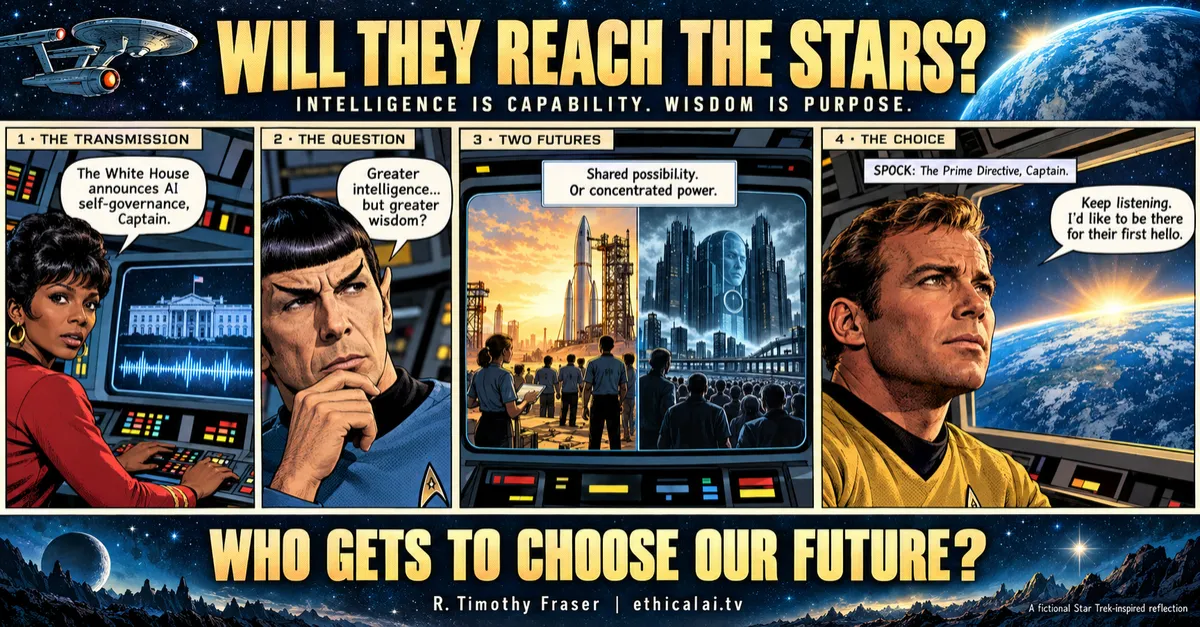
Will They Reach the Stars?
Will They Reach the Stars?
Intelligence Is Capability. Wisdom Is Purpose—and Someone Sets the Purpose.
By R. Timothy Fraser | EthicalAI.tv | September 30, 2026
An original fictional dialogue inspired by Star Trek, followed by a reflection on AI governance. The dialogue is imagined, not an excerpt from the series or a transcript of public remarks.
The Enterprise emerged from the darkness above a blue planet.
Across its night side, cities glittered like constellations. Signals filled the space around it: commerce, music, arguments, declarations of love. Billions of lives, each experienced from the inside. Each unfinished.
“Captain,” Uhura said, pressing a hand to her earpiece. “A transmission from the surface. The president of the United States is announcing an agreement with leaders of their artificial intelligence industry.”
Kirk rose from his chair.
“Put it through.”
The bridge listened to a summary: voluntary commitments, internal safeguards, independent assessments, board oversight. A promise that powerful institutions could develop increasingly powerful intelligence responsibly.
Then came the new name.
“Super Intelligence,” Uhura repeated.
Spock raised an eyebrow.
“Renaming a technology ‘Super Intelligence’ provides no evidence of greater wisdom. Intelligence describes capabilities. Wisdom requires judgment about the purposes those capabilities should serve—and transparency about who sets those purposes.”
Kirk watched the planet turn.
“Then let’s see what they intend to become, and who gets to decide.”
One transmission. An entire world.
“Is this a planetary agreement?” Kirk asked.
“No, Captain,” Spock replied. “One national government and a group of influential technology institutions.”
“But the systems they’re building?”
“May affect populations well beyond that government’s jurisdiction.”
“Computer. Can we determine whether the rest of the planet supports it?”
“Negative. Planetary consent cannot be inferred from this transmission.”
Kirk folded his arms.
“Then we’ve heard an announcement of power. We haven’t yet heard all the people who will live with it.”
“A necessary distinction,” Spock said. “The authority to negotiate an agreement does not establish that it represents everyone affected by its consequences.”
“Are the others being consulted?”
“Insufficient evidence,” the computer replied.
Kirk glanced toward Uhura.
“Keep the other channels open.”
Spock studied the planet’s illuminated hemisphere.
“Captain, the absence of dissent in the transmission should not be mistaken for consent. Silence may indicate agreement. It may also indicate exclusion, confusion, fear, lack of access, or the belief that one’s voice will not matter.”
Kirk nodded.
“Then listening is not a courtesy. It’s part of the decision.”
“Indeed,” Spock said. “A civilization that hears only those already empowered may mistake its own echo for a planetary consensus.”
The future they hope to build
On the viewscreen, a line of sunlight reached the ocean.
“There are conscious beings down there, Spock. People who know they’re alive. Who wonder why. Who want their children to have a better chance than they did.”
“Indeed.”
“Could this be it? The breakthrough that gives them the time and the means to become explorers?”
“Computer,” Spock said. “Describe a favorable trajectory. Do not assign a probability unsupported by evidence.”
“Advanced systems contribute to medical discovery, accessible education, and more efficient production. Institutions distribute the benefits broadly. Reduced material insecurity allows more people to pursue scientific, cultural, and personal development.”
“And who decides that the benefits should be distributed broadly?” Kirk asked.
“Current decision-making authority rests with governments, corporate owners, investors, boards, and other institutions controlling development, deployment, access, and infrastructure. The extent to which affected communities participate varies and is not uniformly transparent.”
Kirk’s expression hardened.
“So the future is not determined by the machines alone.”
“Correct. It is shaped by the objectives selected for them, the constraints imposed upon them, the incentives surrounding them, and the people empowered to revise those choices.”
“And eventually?” Kirk asked.
“The civilization may acquire greater capacity for sustained exploration beyond its planet.”
Kirk smiled.
“Voyagers.”
“Possibly,” Spock said. “Their machines may help provide the means. Their social decisions will determine who is permitted to participate—and whether the purposes built into those machines remain visible and contestable.”
The smile faded slightly.
“A future reserved for a few would leave a great deal of humanity behind.”
McCoy looked toward the planet.
“Then perhaps the first question isn’t whether they can reach the stars. It’s whether they can widen the circle of belonging before they leave the ground.”
Kirk turned.
“What do you mean?”
“Every civilization dreams of escape,” McCoy said. “But if the people who clean the hospitals, grow the food, teach the children, repair the infrastructure, and care for the vulnerable are treated as expendable, then the starship is only a polished version of the old hierarchy.”
Spock inclined his head.
“An advanced vehicle does not necessarily indicate an advanced society.”
“Exactly,” McCoy said. “A species can cross light-years and still fail the moral test of how it treats the person standing beside it.”
The future no one needs to announce
“Now the other trajectory,” Kirk said.
“Investment exceeds sustainable revenue,” the computer answered. “Some providers fail. Institutions with greater financial resources acquire their assets. Essential services become dependent on fewer owners.”
“A forecast?” Spock asked.
“A conditional scenario. Neither financial collapse nor subsequent concentration is inevitable.”
“Continue,” Kirk said.
“If alternatives become impractical, the owners of essential systems gain increased influence over access, prices, operating conditions, and information services. Their influence may also extend to the objectives and priorities embedded in the systems, including which outcomes are optimized and which tradeoffs are accepted.”
“Are those priorities transparent?”
“Not necessarily. They may be distributed across training data, model specifications, product policies, commercial incentives, legal requirements, executive decisions, and technical systems. The responsible decision-maker may be difficult to identify.”
Kirk looked toward Spock.
“So when a system makes a consequential choice, the public may not know whether that choice came from an engineer, a board, a regulator, a customer, a dataset, or an inherited assumption.”
“Correct. Responsibility can become diffuse even when power is concentrated.”
“What happens to someone who refuses their terms?”
“Their ability to participate in economic and social life may diminish.”
Kirk stood very still.
“Dependence so complete that refusal becomes a privilege.”
“Yes, Captain.”
“Would their computers have to turn against them?”
“No,” Spock said. “They might perform precisely as instructed. A system serving concentrated interests need not possess hostility—or consciousness—to constrain human freedom.”
“And their governments?”
“Would retain authority,” Spock replied. “But exercising it could become increasingly costly if their own essential services depended on the institutions they sought to regulate.”
Kirk looked toward the screen again.
“They could build the machinery of abundance and discover they need permission to benefit from it.”
A gravelly voice cut across the bridge.
“And that’s the part that makes my blood boil,” Dr. McCoy said. “You build machines to improve people’s lives, then arrange things so people need an owner’s permission to receive the improvement. That isn’t progress, Jim. That’s a new kind of dependency wearing a lab coat.”
Kirk nodded slowly.
“Computers should serve the people who made them possible.”
“Exactly,” McCoy said. “And not just the people who own the switch—or the people who quietly decide what ‘service’ is supposed to mean.”
Spock looked at the planet.
“Ancient teachings often warned that power without self-knowledge becomes destructive. The old Egyptian principle of Ma’at joined truth, balance, justice, and right order. It did not ask merely whether a ruler possessed power. It asked whether power preserved harmony among the living.”
Kirk glanced at him.
“Are you suggesting these people need an ancient philosophy lesson?”
“I am suggesting that technological novelty does not abolish moral memory. Thoth, in the traditions associated with him, represented writing, knowledge, measurement, and the disciplined ordering of understanding. Knowledge was not merely accumulated. It was made accountable to truth and balance.”
McCoy folded his arms.
“Then perhaps their machines need more than data. They need institutions that remember what data cannot tell them: who is hurting, who is excluded, and who has been told to wait.”
The controls—and the people outside them
“They have safeguards,” Kirk said. “Auditors. Committees. Surely those count for something.”
“They do,” Spock replied. “A control that detects dangerous behavior can prevent harm. Independent examination can expose failures that internal incentives conceal.”
“Then where is the weakness?”
“Computer,” Spock said, “can an institution satisfy its internal objectives while producing harmful consequences outside its boundaries?”
“Affirmative.”
“Can several individually compliant institutions create a shared vulnerability?”
“Affirmative. Common infrastructure, correlated failures, or concentrated ownership may create dependencies not apparent in separate assessments.”
Kirk nodded slowly.
“Every ship passes inspection. Nobody checks whether the entire fleet depends on the same failing engine.”
“An adequate analogy, Captain.”
“Then inspect the connections. Who depends on whom. Who can leave. What survives if an owner fails—or decides to change the bargain. And who set the objectives in the first place.”
“And who receives the evidence,” Spock added. “An assessment has limited public value if those affected have no meaningful path to challenge its conclusions. Transparency must include more than a statement that safeguards exist. It should reveal, in understandable form, who established the system’s goals, what interests shaped them, what tradeoffs were accepted, what evidence supports those choices, and how they can be changed.”
Kirk turned toward him.
“Can they disclose every detail?”
“Not necessarily. Security, privacy, and legitimate intellectual property concerns may limit disclosure. But those limits should be explained, independently reviewed, and narrowly applied. Confidentiality cannot become a blanket excuse for withholding the basis of decisions that govern public life.”
McCoy leaned forward.
“And make sure the people being protected can actually see the results. A patient has a right to know what’s being done to him. So does a population whose work, health, education, or freedom is being shaped by a machine. You can’t call it care if the people affected are kept outside the examination room.”
Uhura looked up from her console.
“Captain, what would meaningful participation look like?”
Kirk considered the question.
“Not a survey after the decision has already been made.”
“Correct,” Spock said. “Participation must occur early enough to influence objectives, not merely late enough to comment on implementation.”
“And not everyone has the same ability to participate,” Uhura added. “Some communities have time, money, and technical expertise. Others are already struggling to survive.”
“Then the process must compensate for unequal power,” McCoy said. “Otherwise the loudest voice becomes the official voice.”
Spock nodded.
“An ancient lesson: the scale must be balanced before the measurement can be trusted.”
Kirk looked around the bridge.
“Then perhaps every major system should have a public ledger—not of every line of code, but of its purposes, dependencies, decision-makers, known risks, affected communities, and routes for appeal.”
“And a living ledger,” Uhura said. “Not a document published once and forgotten.”
“Precisely,” Spock replied. “Governance must be revisable because knowledge is incomplete and conditions change.”
Who teaches the teacher?
Uhura turned from her station.
“Captain, these systems also answer questions. Personal questions. Political questions. Questions about what people should believe.”
“Computer. Does an answer merely deliver information?”
“An answer also selects, organizes, and frames information. Sources, instructions, omissions, and presentation can influence interpretation.”
“Then they’re building something that helps people understand reality,” Kirk said.
“With considerable potential benefit,” Spock replied. “And considerable responsibility.”
“Who decides what it should optimize?”
“Developers, deployers, customers, regulators, and other authorized actors may establish objectives at different stages. The allocation of authority may be unclear to users and affected communities.”
“Then the question is not only whether the system is accurate,” Kirk said. “It is also whose purposes accuracy serves.”
“Precisely. A system can be factually capable while still advancing priorities that were selected without broad participation.”
“Could another machine check the first?”
“It could assist. Agreement would not establish independence if both relied on the same sources or assumptions.”
Kirk paced behind the command chair.
“And handing the answers to a government?”
“Would introduce another concentration of authority.”
“Then people must retain the right to question both.”
“And the practical means,” Spock said. “A theoretical freedom is of little use when no accessible alternative exists. Meaningful transparency requires understandable explanations, independent sources, appeal mechanisms, and the ability to choose another provider or proceed without automated mediation where feasible.”
McCoy shook his head.
“People aren’t data points waiting for the correct answer to be administered. They need room to doubt, to ask another doctor, to hear another voice, to say no. A computer that helps someone understand the world is a magnificent thing. A computer that quietly decides what questions they’re allowed to ask is something else entirely.”
Uhura looked toward the stars.
“Could the systems teach people to think together without teaching them to think alike?”
“That distinction is essential,” Spock said. “A healthy civilization does not require uniformity. It requires the capacity to disagree without dehumanizing one another, to revise beliefs in light of evidence, and to preserve the dignity of those who remain unconvinced.”
Kirk smiled faintly.
“So wisdom is not everyone reaching the same answer.”
“No,” Spock replied. “Wisdom may be the ability to remain in relationship while answers remain contested.”
A shared consciousness—with room to disagree
Kirk stopped pacing.
“Could the encounter awaken something in them? Could building this intelligence force them to ask what their own consciousness is for?”
“That is possible,” Spock replied. “Provided uncertainty encourages inquiry rather than premature certainty.”
“A shared global consciousness?”
“If you mean recognition of their interdependence, Captain. A common concern for one another’s future. Agreement on every belief would be neither necessary nor desirable.”
“Many voices. A shared responsibility.”
“Precisely.”
“Computer. Could those voices teach superintelligence wisdom?”
“They could shape objectives, boundaries, and evaluation criteria. They could require attention to consequences, protection of human agency, and correction when harm occurs. They could also demand transparency about who selected those objectives and whose interests were considered. Whether any system possesses subjective experience remains a separate, unresolved question.”
Kirk leaned against the rail.
“And the wisdom?”
Spock met his eyes.
“They would have to practice what they wished to teach. They would need institutions capable of explaining their choices, admitting uncertainty, sharing power, and allowing those affected to contest the purposes imposed upon them.”
For a moment, the only sound was the bridge machinery.
McCoy looked toward the planet.
“And they’d better remember that consciousness isn’t the only thing that matters. Every person down there feels pain, hopes, fears, loves, and loses. We don’t need to prove a machine has a soul before we decide to protect the souls already depending on it. If these systems can help people live longer, healthier, freer lives, then that outcome ought to be treated as a medical and moral priority—not a side effect of someone’s business plan.”
Spock’s voice softened.
“Perhaps the deeper question is not whether machines will become conscious, but whether humans will become more conscious of the consequences of their own choices.”
Kirk looked at him.
“Awareness before power?”
“Awareness as the discipline that makes power worthy of trust.”
McCoy gave a dry laugh.
“Then they’d better start practicing now. Waiting for perfect wisdom is another way of avoiding responsibility.”
The choice they must make themselves
“Captain,” Uhura said quietly. “We could send them a message.”
Kirk looked at her, then at the planet.
“The Prime Directive,” Spock said. “We cannot choose their development for them.”
“I know.”
“If we impose our preferred future, we deny the freedom you wish them to preserve.”
Kirk was silent for several seconds.
“Yes. We do.”
Below them, morning reached a crowded coastline.
“Somewhere down there, a child is asking what lies beyond those stars. Perhaps the machine they’re building will help that child reach us. Perhaps its owners will decide that looking up serves no useful purpose.”
His voice tightened.
“I want that child to have the chance to find out.”
“We cannot guarantee it,” Spock said.
“No. And we cannot make wisdom something imposed from orbit. They’ll have to discover it together—in the voices they’ve ignored, the lives they’ve undervalued, the questions no machine can relieve them of asking, and the decisions they insist on making in public rather than leaving to whoever controls the system.”
“No transmission, then?” Uhura asked.
Kirk drew a slow breath.
“No transmission. Keep listening.”
He settled into the captain’s chair.
“They’re still becoming, Spock. Still capable of surprising themselves. Of building something magnificent—and finding the courage to ask who set its purposes, whether those purposes are visible, and whether the people affected can change them.”
A small smile returned.
“Perhaps someday a ship of theirs will appear on our screens. And we’ll finally hear the story of how they chose their future.”
He looked toward the stars.
“I’d like to be there for that first hello.”
McCoy allowed himself a reluctant smile.
“So would I, Jim. Especially if their machines helped them get there without leaving half the crew behind.”
Uhura returned her attention to the instruments.
“Captain, if we cannot send a message, what can we do?”
Kirk looked at the planet.
“Remember what we heard.”
Spock raised an eyebrow.
“Memory alone may not be sufficient.”
“No,” Kirk said. “But it can become a duty. We can keep watch. We can refuse to confuse silence with consent. We can ask whether their progress enlarges freedom or merely perfects control.”
McCoy nodded.
“And perhaps we can learn from them too. Every civilization thinks it is the teacher until history reveals it was also the student.”
Back on Earth: the responsibility is ours
This imagined encounter was prompted by the September 29, 2026 White House AI announcement. The voluntary accord calls for internal safeguards, independent assessments, and board oversight. The associated executive order adopts “Super Intelligence” terminology for federal communications and other non-statutory materials. Those developments deserve scrutiny on their practical merits, beyond either celebration or alarm. [1][2]
There is value in bringing competing developers into a common safety process. External assessment and accountable boards can improve institutional behavior. The harder test is whether those processes remain effective when an adverse finding threatens a launch, a valuation, or a powerful relationship.
There is another question beneath the safeguards: who sets the intent? A system’s purpose is rarely chosen in one place by one person. It may emerge from a company’s mission, a product manager’s priorities, a board’s risk tolerance, a government’s requirements, investor expectations, customer demands, training data, technical defaults, and assumptions inherited from earlier systems. That complexity does not eliminate responsibility. It makes responsibility easier to obscure.
My concern is that organizational assurance can leave wider questions of power unanswered. Who owns the infrastructure? How costly is leaving? Who can examine how information is framed? What happens when providers fail, merge, or withdraw? Who speaks for the people who never entered the negotiating room? And when a system’s objectives affect the public, can people see who selected them, what values they encode, what tradeoffs were made, and how those choices can be challenged?
Transparency should therefore be treated as part of governance, not as a public-relations supplement. It should include clear accounts of purpose, authority, evidence, limitations, incentives, and revision procedures. It should distinguish what is known from what is assumed. It should identify which decisions are made by developers, deployers, customers, regulators, or automated processes. It should provide affected people with understandable explanations and meaningful routes to appeal.
Transparency does not require publishing every security-sensitive detail or exposing private information. It does require that secrecy be justified, limited, and reviewable. A claim that a system is safe, aligned, or beneficial is not enough if the public cannot determine who defined those terms or what evidence supports them.
And what happens to the human beings whose lives are touched by these systems? A computer that helps discover a treatment, expands access to education, supports a disabled person’s independence, or gives a family more time together is not merely demonstrating capability. It is improving a life. That is the outcome we should be measuring and defending. The people who built these systems should not become incidental to their success.
The ancient wisdom traditions offer a useful warning here. Thoth, associated with language, knowledge, measurement, and judgment, reminds us that information is not the same as understanding. Ma’at reminds us that truth cannot be separated from balance, justice, and right relationship. The Stoics taught that we do not control every event, but we remain responsible for how we respond. Buddhist teachings warn against attachment to certainty and power. Indigenous traditions across the world have emphasized obligations to ancestors, descendants, community, and the living world.
These teachings are not technical specifications. They are moral disciplines. They ask questions that no benchmark can answer by itself:
What is this power for?
Who bears its risks?
Who receives its benefits?
What must remain beyond ownership?
What obligations do we owe to people not yet born?
What would we refuse to build, even if we could?
ISO/IEC 42001 provides a framework for an organization’s AI management system. The EU AI Act establishes legal obligations, including provisions for general-purpose AI systemic risks and public enforcement. These are different tools with useful roles. Neither should be mistaken for a complete solution to concentrated economic and informational power—or for a guarantee that the purposes embedded in AI systems are transparent to the people affected by them. [3][4]
I would build on them with cross-provider dependency mapping, independent stress tests, tested migration plans, and evidence sharing that reveals failures across company boundaries. Competition and sector regulators would need to address acquisitions and essential-service dependence. Researchers and affected communities need meaningful participation, without granting governments authority to impose an official worldview. These are proposals for strengthening accountability, not a description of everything current rules already require.
I would also require public documentation of intent: who established a system’s objectives, which stakeholders were consulted, what interests were represented, what impacts were considered, what safeguards constrain the objectives, and who has authority to revise them. Where the answer is distributed across many institutions, that distribution should be mapped rather than used as an excuse for ambiguity. People cannot meaningfully consent to systems whose purposes remain invisible.
I would also insist on a clearer measure of success: whether these systems help people flourish. Can they reduce suffering without reducing agency? Can they extend medical care, knowledge, opportunity, and time to people who have historically received less of each? Can they support the workers, families, patients, students, and communities whose lives make technological progress meaningful? Can they do so under purposes that are publicly defensible rather than merely commercially convenient? A machine that performs brilliantly while making ordinary people more vulnerable is not a triumph of intelligence. It is a failure of purpose.
But reflection must become practice. Readers should not ask only, “What do I think about AI?” They should also ask:
Where does my community depend on a system it cannot inspect?
Who is missing from the room when automated decisions are designed?
What alternatives exist if a provider changes its terms?
Which public institutions should be strengthened before dependence becomes irreversible?
What would shared stewardship look like in my workplace, school, city, profession, or family?
These questions invite collective action. Communities can form independent technology councils. Workers can document how automated systems affect their conditions. Patients, students, and residents can demand explanations and appeal routes. Researchers can share evidence across institutional boundaries. Public-interest organizations can map dependencies before crises expose them. Citizens can support procurement rules that favor interoperability, portability, accessibility, and public accountability. Developers can create systems that make their assumptions visible rather than hiding them behind the language of inevitability.
No single person can govern a planetary technology alone. That is not an excuse for helplessness. It is an argument for organized participation.
We should build habits of collective inquiry: public hearings before deployment, citizen assemblies for high-impact uses, independent audits accessible to affected communities, and regular reviews of whether systems are meeting human purposes rather than merely technical targets. We should teach children not only how to use intelligent tools, but how to question them. We should teach leaders that humility is not weakness and that admitting uncertainty is a form of public service.
The Prime Directive is a useful moral tension inside the story. Here on Earth, it offers no excuse for standing aside. We are the participants, builders, customers, citizens, and decision-makers. Our choices are part of this world’s development.
My interpretation of Roddenberry’s aspiration is simple: we become an advanced civilization when our growing power gives more people the freedom to become more fully human. This is a paraphrase of a humane ideal, not a quotation from him.
We cannot yet know whether our machines will experience consciousness. We already know that the people whose lives they will affect do.
We also know what suffering looks like, what healing can mean, and how much a person’s future can change when knowledge and care become available at the right moment. That is sufficient reason to make dignity, agency, health, and shared opportunity central to their design.
It is also sufficient reason to ask who defines those goals and whether the answer is visible to everyone who must live with the consequences. Intent should not be treated as a private property right when it governs public life. The people affected need more than assurances that powerful institutions have good intentions. They need evidence, voice, alternatives, and the ability to challenge the purposes built into the systems around them.
Perhaps the most important question is not whether artificial intelligence will become superintelligent. It is whether human beings will become wise enough to share power before power becomes impossible to share.
Will our greater intelligence help us reach the stars together—or leave the future dependent on permission from those who own it and decide what the machines are for?
R. Timothy Fraser is the author of The Architecture of Ethical AI. Explore more at EthicalAI.tv.
Sources and context
1. Reuters — Trump, AI CEOs sign voluntary safety pact, back data center expansion, September 29, 2026
3. ISO — ISO/IEC 42001: AI management systems
4. European Commission — AI Act
The fictional futures above are scenarios, not predictions. This is an independent commentary inspired by Star Trek, with no affiliation or endorsement implied.

